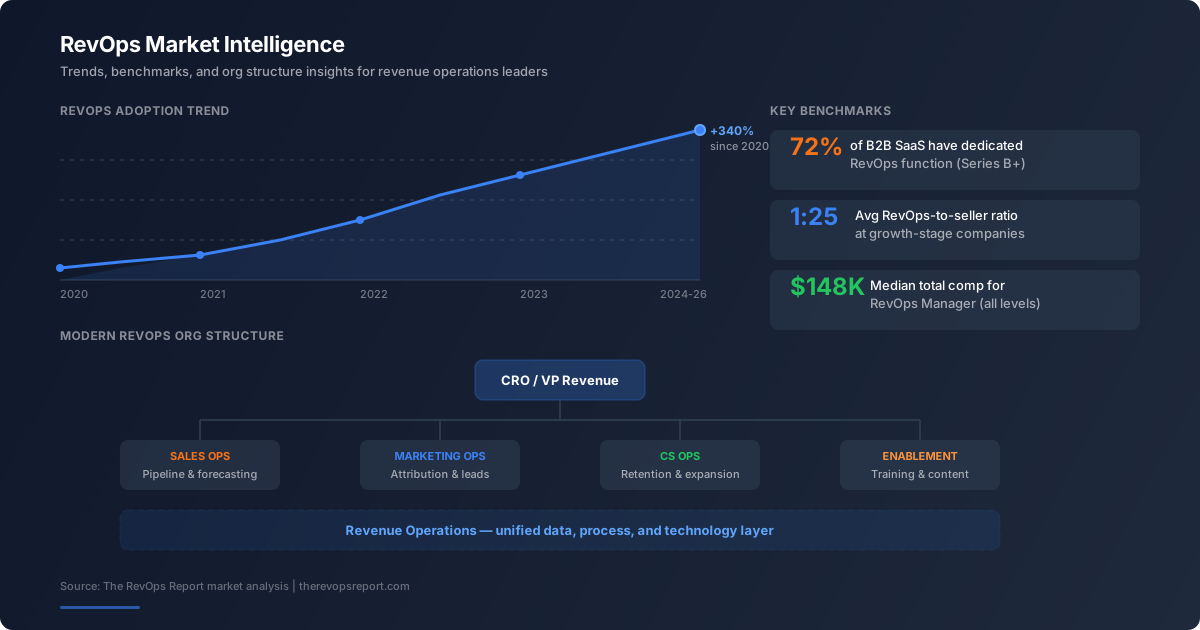
Clear, practical definitions of 63 Revenue Operations terms, from pipeline velocity to tech stack consolidation.
Each term links to relevant salary data, tool reviews, and analysis.
A go-to-market strategy that concentrates sales and marketing resources on a defined set of target accounts, using personalized campaigns to penetrate specific organizations.
A go-to-market strategy that targets specific high-value accounts with coordinated, personalized campaigns rather than casting a wide net with broad lead generation. Marketing and sales work the same ...
The annualized revenue value of a customer contract, normalizing multi-year or monthly deals to a consistent yearly figure for pipeline and revenue analysis.
The annualized value of all active recurring subscription revenue. The north star metric for SaaS companies, used for benchmarking, valuation, and strategic planning.
The group of stakeholders within a B2B organization who collectively influence or make a purchase decision, typically including a champion, economic buyer, technical evaluator, and legal/procurement.
The percentage of customers or revenue lost over a given period. Logo churn measures lost accounts; revenue churn measures lost dollars, which can differ significantly due to account size variation.
The total revenue a business expects to earn from a customer account over the entire duration of the relationship, used to guide acquisition spending, segmentation, and retention investment.
Technology that records, transcribes, and analyzes sales calls to extract deal insights, coaching signals, and forecast data. Gong and Chorus are the category leaders.
Software that automates the configuration of complex product offerings, applies pricing rules, and generates accurate quotes, eliminating spreadsheet-based quoting and reducing deal cycle friction.
The software platform that serves as the system of record for customer and prospect data, pipeline management, and revenue reporting. The foundation of every revenue tech stack.
The total cost to acquire a new customer, calculated by dividing all sales and marketing expenses by the number of new customers acquired in a given period.
The operational function supporting customer success teams through health scoring, renewal forecasting, onboarding workflows, and expansion revenue tracking.
The invisible portion of the buyer's journey that happens in channels your analytics can't track: Slack communities, podcasts, word of mouth, private social, and peer conversations.
The process of appending third-party data to existing records to fill gaps: firmographics, technographics, contact info, intent signals. A core RevOps data infrastructure task.
The ongoing process of maintaining clean, accurate, and standardized data in CRM and marketing systems through deduplication, enrichment, validation, and governance practices.
The practice of maintaining clean, accurate, and deduplicated data in CRM and marketing systems. Includes deduplication, normalization, enrichment, and decay management. RevOps owns this as a continuo...
A centralized function that manages non-standard deal approvals, pricing exceptions, contract terms, and complex deal structuring to accelerate sales cycles while protecting margins.
Deal velocity measures the speed at which individual deals progress through pipeline stages, from opportunity creation to closed-won, helping RevOps identify bottlenecks and forecast close dates more ...
A marketing strategy focused on creating awareness and interest in a product to build qualified pipeline, encompassing inbound content, outbound campaigns, events, ABM, and paid media.
The measurement of how closely a revenue forecast predicts actual results, typically expressed as the percentage deviation between forecasted and actual revenue.
The strategy and execution plan for bringing a product or service to market, encompassing target audience, messaging, channels, pricing, and the coordinated actions of Sales, Marketing, and Customer S...
An emerging role that combines RevOps domain knowledge with software engineering skills to build custom GTM workflows, API integrations, and data pipelines that go beyond what no-code tools can handle...
A detailed description of the company type most likely to become a successful, long-term customer, defined by firmographic, technographic, and behavioral attributes that correlate with high lifetime v...
Behavioral signals that indicate a company or individual is actively researching or considering a purchase, collected from web activity, content consumption, and third-party data sources.
The automated process of assigning inbound leads and accounts to the right sales rep based on territory, segment, account ownership, round-robin rules, or custom logic.
A methodology for ranking prospects based on demographic fit (firmographic data) and behavioral engagement (actions taken) to prioritize sales follow-up.
A numerical model that ranks prospects by fit (firmographic attributes) and engagement (behavioral signals). RevOps builds and tunes the model, and the MQL threshold determines when leads are handed t...
A B2B sales qualification framework built around six criteria: Metrics, Economic Buyer, Decision Criteria, Decision Process, Identify Pain, and Champion. RevOps enforces it through CRM fields and stag...
The predictable monthly revenue from all active subscriptions, normalized to a monthly amount. The foundational metric for SaaS financial health and growth tracking.
A lead that has been evaluated by marketing based on engagement signals and firmographic fit, and deemed ready for sales follow-up according to agreed-upon criteria.
A methodology for distributing conversion credit across multiple marketing touchpoints in the buyer journey, replacing simplistic first-touch or last-touch models with more accurate revenue impact ana...
The percentage of recurring revenue retained from existing customers over a period, including expansion (upsells, cross-sells) and contraction (downgrades, churn).
The ratio of total pipeline value to revenue quota or target. A 3-4x coverage ratio is typically considered healthy. RevOps tracks this metric to predict forecast gaps and trigger corrective action ea...
A composite metric measuring how quickly revenue moves through the sales pipeline, calculated as (number of opportunities × win rate × average deal size) ÷ sales cycle length.
A go-to-market strategy where the product itself drives customer acquisition, conversion, and expansion through free trials, freemium tiers, and in-product upgrade prompts.
The percentage of a sales rep's or team's assigned revenue target that is achieved in a given period. The primary measure of sales productivity and quota-setting accuracy.
Revenue attribution is the process of assigning credit for closed revenue to the marketing touchpoints, campaigns, and channels that influenced the buyer's journey from first touch to closed deal.
A technology category that automatically captures and analyzes buyer-seller interactions across calls, emails, and meetings to surface deal insights, improve forecasting accuracy, and guide rep behavi...
Lost revenue from process gaps: missed renewals, pricing errors, manual handoff failures, broken workflows, and untracked discounts. RevOps exists to find and plug these leaks.
The strategic alignment of sales, marketing, and customer success operations to drive full-funnel revenue efficiency through shared data, processes, and technology.
A documented, repeatable process for executing specific revenue motions: new logo acquisition, expansion, competitive displacement, win-back. RevOps builds and maintains playbooks that standardize exe...
A framework (originally from SiriusDecisions/Forrester) mapping the full journey from initial inquiry to closed revenue through defined stages: Inquiry, MQL, SAL, SQL, SQO, and Closed Won.
The collection of tools a RevOps team manages: CRM, sales engagement, data enrichment, BI, marketing automation, and conversation intelligence. Integration and data flow between tools is the real chal...
Sales capacity planning is the process of modeling how many sellers a company needs to hit its revenue target, accounting for ramp time, attrition, quota attainment distribution, and territory coverag...
The sales efficiency ratio (also called the Magic Number) measures how much new revenue is generated for every dollar spent on sales and marketing, indicating whether the go-to-market engine is scalin...
The function that provides sales teams with the content, training, tools, and data they need to close deals. It sits between marketing and sales, and RevOps provides the underlying data and process la...
The structured approach a sales organization uses to move deals through the pipeline. Common methodologies include SPIN Selling, Challenger, Sandler, and MEDDIC. RevOps operationalizes the chosen meth...
The function responsible for optimizing sales team efficiency through CRM management, territory design, quota setting, forecasting, and sales process design.
A lead that has been vetted by both marketing and sales as ready for direct sales engagement, meeting agreed-upon criteria for budget, authority, need, and timeline.
A metric measuring how fast individual deals move through pipeline stages, used to identify bottlenecks, benchmark rep performance, and predict revenue timing at the deal level.
Sales Development Representatives and Business Development Representatives. The front-line outbound (and sometimes inbound) role that generates qualified pipeline for Account Executives. RevOps owns t...
The collection of software tools and platforms a company uses to operate its revenue functions, including CRM, marketing automation, sales engagement, analytics, and data enrichment tools.
Territory management is the process of designing, assigning, and optimizing sales territories to ensure balanced opportunity distribution, maximum market coverage, and fair quota assignment across the...
The process of dividing a company's total addressable market into geographic, industry, or account-based segments and assigning sales resources to maximize coverage and revenue potential.
Customer Acquisition Cost (CAC) is the total cost of acquiring a new customer, calculated by dividing all sales and marketing expenses by the number of new customers acquired in a given period.
Lead scoring is a methodology that assigns numerical values to prospects based on demographic fit and behavioral engagement to prioritize which leads deserve immediate sales attention.
Net Revenue Retention (NRR) measures the percentage of recurring revenue retained from existing customers over a period, including expansion revenue (upsells, cross-sells) and subtracting contraction ...
Pipeline velocity measures how quickly revenue moves through the sales pipeline, calculated as (number of opportunities x win rate x average deal size) divided by sales cycle length in days.
Quota attainment is the percentage of a sales rep's assigned revenue target achieved in a given period, serving as the primary measure of individual seller performance and a critical input to capacity...
RevOps (Revenue Operations) is the strategic function that unifies sales, marketing, and customer success operations under a single team to eliminate silos, improve data accuracy, and accelerate reven...
The percentage of sales opportunities that result in a closed-won deal, measured from a defined pipeline stage. One of the four components of pipeline velocity.
Get Weekly RevOps Intelligence
Get weekly market data + quarterly State of RevOps reports. Free.