CRM
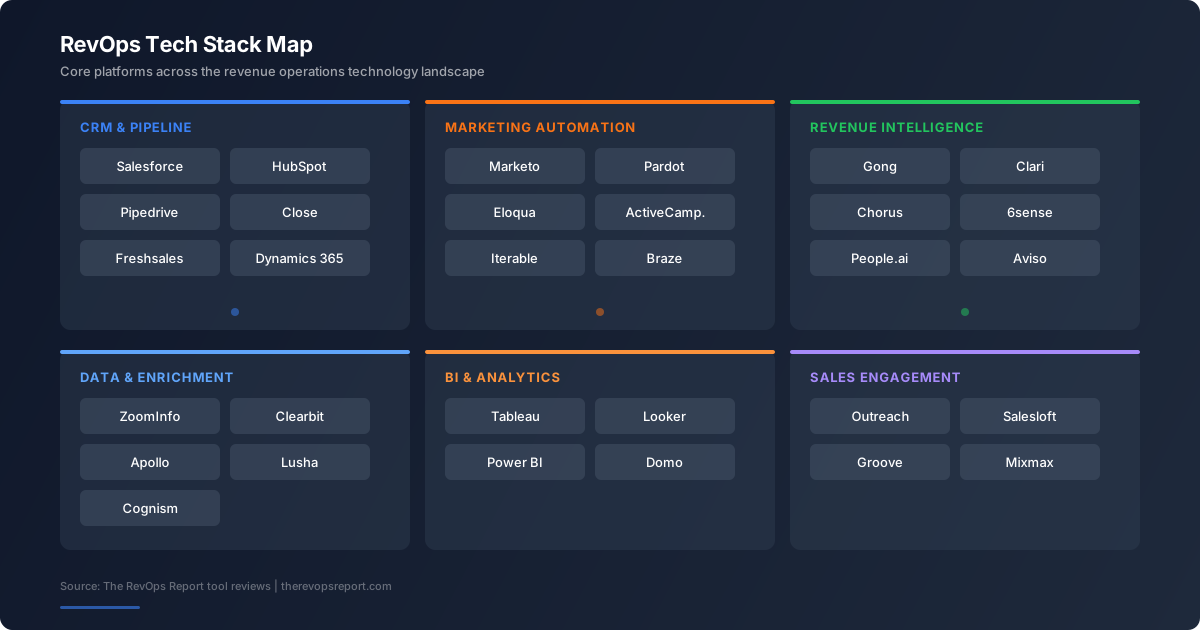
The foundation of your revenue operations stack. CRM platforms that RevOps teams configure, maintain, and optimize for pipeline visibility and data integrity.
Reviews
Salesforce
The dominant enterprise CRM. RevOps teams spend 40%+ of their time configuring, cleaning, and reporting from Salesforce. It's the system of record for pipeline, and its flexibility is both its greatest strength and biggest operational headache.
In-Depth
HubSpot
The all-in-one CRM that RevOps teams at SMB and mid-market companies rely on for unified marketing, sales, and service data. Operations Hub gives RevOps dedicated workflow, data sync, and programmable automation tools.
Comparisons
Salesforce vs HubSpot: CRM Comparison for RevOps
The definitive CRM comparison. Enterprise flexibility and ecosystem vs. unified simplicity and Operations Hub. The choice that shapes your entire stack.
Comparison
HubSpot vs Salesloft: Engagement for RevOps
Built-in engagement vs. dedicated platform. HubSpot bundled simplicity vs. Salesloft depth (now with Clari forecasting).
ComparisonSalesforce vs Dynamics 365: CRM Comparison for RevOps
Enterprise CRM showdown. Salesforce ecosystem dominance vs. Microsoft platform economics and ERP integration.
Sales Engagement
Sequencing, cadences, and prospect engagement platforms. The tools RevOps teams deploy and measure for outbound execution and rep productivity.
Reviews

Outreach
Enterprise sales engagement platform RevOps teams deploy for multi-channel sequences. Outreach gives ops the analytics and governance controls needed to standardize outbound execution across large teams.
In-DepthSalesloft
Sales engagement platform now merged with Clari (Dec 2025). For RevOps teams, the Clari+Salesloft combination means engagement data flows directly into forecasting. The question is whether the integration delivers or creates more complexity.
In-Depth
Reply.io
Multichannel sales engagement with AI writing assistance. A budget-friendly option RevOps teams deploy when the team doesn't need enterprise-grade governance but wants email + LinkedIn + calls in one workflow.
In-Depth
Instantly
Cold email platform with unlimited sending accounts and built-in warmup. RevOps teams evaluate Instantly when outbound is high-volume email and the priority is deliverability over multi-channel orchestration.
In-Depth
DealHub
Agentic CPQ platform with deal rooms and subscription billing. For RevOps teams managing complex quoting processes, DealHub replaces spreadsheet-based pricing with no-code configuration and approval workflows.
In-Depth
PandaDoc
Document automation and e-signature with CPQ capabilities. RevOps teams use PandaDoc when the quoting process is relatively simple and the priority is speed-to-signature over complex pricing logic.
In-Depth
Highspot
Sales enablement and content management platform. RevOps teams use Highspot to govern what content reps share, measure content effectiveness on deals, and connect training to revenue outcomes.
In-Depth
Seismic
Enterprise sales enablement platform with LiveDocs content automation, buyer engagement analytics, and learning & coaching. Seismic competes with Highspot at the enterprise tier with deeper content personalization and more granular analytics.
In-Depth
Showpad
Mid-market sales enablement platform that balances content management with coaching and training. Showpad targets teams that want enablement capabilities without the enterprise overhead of Highspot or Seismic.
In-Depth
Guru
AI-powered knowledge management platform that lives where reps work: Chrome extension, Slack, Salesforce sidebar. For RevOps teams that realized they don't need a full enablement platform and just need reps to find information quickly.
Comparisons
Outreach vs Salesloft: Sales Engagement for RevOps
The definitive comparison for RevOps teams choosing between the two dominant sales engagement platforms.
ComparisonDealHub vs PandaDoc: CPQ Comparison for RevOps
Full CPQ platform vs document automation with e-sign. The choice depends on your quoting complexity and RevOps maturity.
ComparisonInstantly vs Reply.io: Email Engagement for RevOps
Email-only specialist vs multichannel platform. RevOps teams pick based on whether the outbound motion is email-first or multi-channel.
Comparison
Apollo vs Outreach: Is Apollo Enough to Drop Outreach?
Is Apollo enough to replace Outreach? Data quality, engagement features, admin overhead, and total cost compared for RevOps teams.
ComparisonSalesloft vs Apollo: Engagement for RevOps
Enterprise engagement with coaching vs. all-in-one value play. Governance and forecasting vs. simplicity and cost.
ComparisonOutreach vs Instantly: Engagement for RevOps
Enterprise SEP with governance vs. affordable cold email at scale. Full kitchen vs. microwave for outbound.
ComparisonHighspot vs Seismic: Sales Enablement for RevOps
The two enterprise sales enablement leaders. Training and coaching (Highspot) vs content automation and analytics (Seismic).
Data & Analytics
Data enrichment, cleansing, routing, and intelligence platforms. The data infrastructure RevOps owns to keep the GTM engine running on clean fuel.
Reviews

Clay
Waterfall data enrichment with 75+ providers. Clay is the breakout tool for RevOps and GTM engineers who want to build custom enrichment workflows without being locked into a single data vendor's quality ceiling.
In-DepthApollo.io
All-in-one sales intelligence and engagement platform. For RevOps teams at SMB and mid-market companies, Apollo replaces separate data and engagement tools with a single platform at a fraction of the cost.
In-Depth
ZoomInfo
Enterprise B2B contact and company data platform. ZoomInfo is the data standard RevOps teams at large companies run on, but the cost, contract structure, and aggressive sales tactics make it a love-hate relationship.
In-Depth
Warmly
Website visitor identification with AI-powered outbound automation. RevOps teams use Warmly to turn anonymous website traffic into actionable pipeline by de-anonymizing visitors and triggering automated follow-up.
In-Depth
Unify
Intent-driven outbound platform combining 25+ signals with execution. For RevOps teams building signal-based outbound motions, Unify orchestrates the workflow from intent detection through automated outreach.
In-Depth
Openprise
Enterprise no-code data orchestration and automation. Openprise is the heavy-duty data ops platform for enterprise RevOps teams managing complex data flows across CRM, MAP, and data warehouse with 300+ integrations.
In-Depth
Cloudingo
Salesforce-native data deduplication and cleansing tool. For RevOps teams fighting the endless battle against duplicate records in Salesforce, Cloudingo provides matching algorithms and merge workflows without leaving the platform.
In-Depth
LeanData
Lead routing and GTM orchestration platform. LeanData is the tool RevOps teams use to solve the lead-to-account matching and routing problem that causes missed handoffs, slow response times, and incorrect territory assignments.
In-Depth
Demandbase
Enterprise ABM platform with account intelligence and data enrichment. RevOps teams at enterprise companies use Demandbase to orchestrate account-based programs with intent data, advertising, and sales intelligence in one platform.
In-Depth
Verum
AI-powered managed data cleaning, enrichment, and analysis services. For RevOps teams that need data ops done but don't have bandwidth to DIY, Verum provides a managed service alternative to tool-based approaches.
In-Depth
6sense
ABM intent data platform that reveals anonymous buying signals to identify in-market accounts. RevOps teams use 6sense for account prioritization, intent-based routing, and ABM campaign orchestration.
In-Depth
Chili Piper
Inbound scheduling and lead routing platform. RevOps teams deploy Chili Piper to eliminate the speed-to-lead gap between form submission and booked meeting, converting inbound leads into meetings instantly.
In-Depth
Bombora
The largest B2B intent data cooperative, tracking content consumption across 5,000+ publisher sites. Bombora provides company-level intent signals as a data feed that plugs into your existing stack rather than forcing you onto a new platform.
Comparisons
Clay vs Apollo: Data Platform Comparison for RevOps
Waterfall enrichment flexibility vs all-in-one simplicity. The right choice depends on your RevOps team's technical depth and data requirements.
ComparisonZoomInfo vs Apollo: B2B Data for RevOps
Enterprise data standard vs scrappy all-in-one challenger. RevOps teams face this choice when building their data infrastructure.
ComparisonWarmly vs Unify: Visitor Intelligence for RevOps
Two approaches to website visitor intelligence. Warmly focuses on real-time chat. Unify orchestrates multi-signal outbound plays. RevOps teams need different things.
ComparisonZoomInfo vs Clay: Data Enrichment for RevOps
Enterprise data standard vs. waterfall enrichment innovator. Single-source reliability vs. multi-source coverage for your data infrastructure.
ComparisonDemandbase vs ZoomInfo: ABM & Data for RevOps
ABM orchestration platform vs. B2B data powerhouse. Different tools for different GTM motions.
Comparison6sense vs Demandbase: ABM Platforms for RevOps
The ABM platform showdown. Predictive AI vs. advertising-led ABM for account-based revenue teams.
Marketing Automation
AI SDRs, outbound automation, and marketing platforms. The automation layer RevOps evaluates to scale pipeline generation without scaling headcount.
Reviews

11x
AI SDR platform backed by a16z and Benchmark. RevOps teams evaluating AI SDRs need to weigh 11x's high-volume automation against its $60K+ annual commitment and documented quality concerns.
In-Depth
Artisan
AI BDR platform with 'Ava' assistant, Y Combinator backed. Artisan promises all-in-one outbound automation with a 300M+ contact database, but RevOps teams should evaluate contract terms and results consistency before committing.
In-Depth
AiSDR
AI SDR with quarterly contracts and transparent pricing. For RevOps teams testing AI SDR tools, AiSDR is the lowest-risk entry point: quarterly billing, transparent pricing, and sub-10-minute reply handling.
In-Depth
Regie.ai
AI-powered sales engagement with parallel dialer and AI agents. For RevOps teams exploring the AI + human SDR hybrid model, Regie combines AI content generation with built-in phone capabilities.
In-Depth
Marketo
Adobe's enterprise marketing automation platform. RevOps teams manage Marketo's lead scoring, nurturing programs, and the critical Marketo-Salesforce sync that determines MQL handoff quality.
In-Depth
Qualified
Conversational marketing platform built natively on Salesforce. RevOps teams use Qualified to identify target accounts visiting the website and route them to reps in real-time, turning anonymous traffic into pipeline.
In-Depth
Drift
The original conversational marketing platform, now owned by Salesloft/Clari. Drift pioneered chatbot-to-meeting conversion for B2B websites. RevOps teams deploy Drift for pipeline generation through real-time visitor engagement, playbooks, and ABM routing.
In-Depth
Pardot
Salesforce-native marketing automation (officially rebranded to Marketing Cloud Account Engagement). For RevOps teams on Salesforce, Pardot eliminates MAP-CRM sync headaches because it lives inside the Salesforce platform. Lead scoring, nurturing, and Engagement Studio are built on the same data layer as your CRM.
In-Depth
ActiveCampaign
Affordable marketing automation with a surprisingly capable automation builder and built-in CRM. For SMB RevOps teams that need real automation without enterprise pricing, ActiveCampaign delivers 80% of what Marketo does at 10% of the cost.
Comparisons
11x vs Artisan: AI SDR Comparison for RevOps
The two most-hyped AI SDRs compared. Both want annual contracts. Both have red flags. Here's what RevOps teams need to know before signing.
ComparisonArtisan vs AiSDR: AI SDR Comparison for RevOps
Annual lock-in vs quarterly flexibility. The contract terms tell RevOps teams everything they need to know about vendor confidence.
Comparison11x vs AiSDR: AI SDR Comparison for RevOps
The $60K gamble vs the $2,700 test. For RevOps teams managing tool budgets, this comparison isn't close.
ComparisonMarketo vs HubSpot: Marketing Automation for RevOps
Enterprise marketing automation (Adobe) vs all-in-one platform. Scoring sophistication vs total cost and usability.
ComparisonDrift vs Intercom: Conversational Platforms for RevOps
Pipeline-focused conversational marketing vs. multi-department messaging platform. Different tools for different chat strategies.
ComparisonPardot vs HubSpot: Marketing Automation for RevOps
Salesforce-native marketing automation vs. all-in-one platform. Native data flow vs. platform breadth and Operations Hub.
Revenue Intelligence
Conversation intelligence, forecasting, and deal analytics. The tools RevOps uses to give leadership accurate pipeline and forecast visibility.
Reviews

Gong
Market-leading conversation intelligence platform. RevOps teams use Gong for call analytics, deal intelligence, and coaching insights that feed into forecast accuracy and pipeline health metrics.
In-Depth
Clari
Revenue platform for forecasting and pipeline visibility. Clari is the tool RevOps teams deploy to give CROs and board-level stakeholders accurate forecast numbers, replacing spreadsheet-based forecasting with AI-driven predictions.
In-Depth
Chorus.ai
Conversation intelligence platform acquired by ZoomInfo. For RevOps teams already running ZoomInfo, Chorus adds call recording and analytics without adding another vendor to manage.
In-Depth
Sybill
AI sales assistant for CRM automation and deal execution. For RevOps teams fighting CRM data quality issues, Sybill auto-fills CRM fields from call data, reducing the manual entry problem that corrupts pipeline reporting.
Comparisons
Gong vs Clari: Which Is More Accurate for Pipeline Forecasting?
Conversation intelligence vs revenue forecasting for enterprise pipeline management. Which provides better RevOps insights?
ComparisonGong vs Sybill: CI Comparison for RevOps
Enterprise CI leader vs AI-first CRM automation. For RevOps, the question is whether you need coaching data or cleaner CRM data more.
ComparisonClari vs Sybill: Revenue Intelligence for RevOps
Revenue forecasting vs. AI CRM automation. Forecast accuracy (output) vs. data quality at the source (input).
ComparisonGong vs Chorus: CI Comparison for RevOps
Market leader vs. ZoomInfo-bundled option. Feature innovation vs. bundled pricing economics.
Data Hygiene
Deduplication, standardization, enrichment, and validation tools. The data quality layer RevOps owns to keep CRM records clean and reliable.
Reviews
Reltio
Enterprise master data management platform built for organizations where data quality is a board-level concern. Reltio creates a unified data model across CRM, ERP, marketing automation, and support systems, which means it solves a bigger problem than CRM-only dedup tools. The platform uses graph-based matching to identify relationships between records that rule-based tools miss entirely. It's designed for companies with millions of records spread across dozens of systems where a single source of truth doesn't exist yet. Implementation typically runs 3-6 months with dedicated professional services. The price point and complexity put it outside the range of most mid-market RevOps teams, but for enterprise organizations with data sprawl across multiple business units, Reltio is the only tool on this list that addresses the root cause instead of patching symptoms.
Tool ReviewValidity DemandTools
The most widely used Salesforce data quality tool, period. DemandTools handles mass deduplication, standardization, and data manipulation directly inside Salesforce with scenario-based operations that let you preview results before committing changes. RevOps teams with 100K+ records and persistent duplicate problems rely on it for ongoing data governance. The tool supports lead-to-lead, contact-to-contact, and cross-object matching with configurable rules that go well beyond Salesforce's native duplicate management. Batch operations can process millions of records in a single run, which makes it practical for quarterly deep cleans and post-migration cleanup. The interface hasn't been modernized in years, and new admins will need a few days to get comfortable with the workflow, but the underlying capability is why it remains the industry default.
Tool ReviewVerum (Managed Service)
The only managed service on this list. Verum handles dedup, standardization, enrichment, and validation for you rather than handing you another tool to configure. Per-record pricing with no license fees and no implementation project keeps the cost predictable. Send a CSV or Salesforce export, get it back clean with human QA on every record. The service works well for quarterly deep cleans, post-merger data integration, and any situation where your team doesn't have the bandwidth to run DemandTools jobs themselves. Turnaround runs a few business days for most projects. The trade-off is control: you're outsourcing the data cleaning step, which means you don't own the matching logic or build institutional knowledge around your dedup rules.
Enrichment
Data enrichment platforms and services. The tools RevOps teams use to fill gaps in contact and company data across the CRM, prospecting lists, and campaign targets.
Reviews

Clearbit (Breeze)
HubSpot acquired Clearbit in 2023 and rebranded it as Breeze Intelligence, making it the default enrichment layer for HubSpot customers. If you run HubSpot, company-level enrichment (industry, headcount, revenue range, tech stack) happens automatically on new CRM records at no extra cost. The enrichment fires in real time as records enter your CRM, with no manual triggers or scheduled jobs needed. Company data accuracy is strong, particularly for tech companies and mid-market organizations. Contact-level depth is lighter than dedicated providers like ZoomInfo or Cognism. You won't get verified direct dials or multi-source email coverage from Breeze alone. For HubSpot shops, the play is to use Breeze as your baseline company enrichment layer and add a contact-level provider like Apollo or Lusha on top for the gaps it doesn't fill.
Tool Review
Cognism
The strongest B2B data provider for European markets, and the clear choice for RevOps teams selling into the UK, DACH, Nordics, or Southern Europe. Cognism built its reputation on GDPR-compliant data collection and phone-verified mobile numbers through their Diamond Data program, which hand-verifies direct dials for accuracy. This matters because mobile numbers in European markets are harder to source than US numbers, and Cognism's verification process delivers connect rates that ZoomInfo and Apollo can't match in those regions. The platform also covers North American contacts, but the competitive advantage is strongest in European markets. CRM integration with Salesforce and HubSpot is solid, and the Chrome extension works well for LinkedIn-based prospecting. Pricing is annual contract based and runs higher than Apollo but lower than ZoomInfo, positioning Cognism in the mid-tier for budget purposes.
Healthcare Data
Healthcare-specific data platforms and services. Tools that understand NPI taxonomy, provider types, and practice-level decision-makers for RevOps teams selling into healthcare.
Reviews
Provyx
The only vendor purpose-built for healthcare provider data at the practice level. Provyx delivers NPI-verified contacts tied to specific practice types, specialties, and decision-maker roles that generic B2B databases don't carry. The data pipeline pulls from NPI registries, state licensing boards, and multiple verification sources to identify the right person at the right practice. RevOps teams selling into healthcare need data that understands the difference between a hospital system administrator and a solo practice owner, and Provyx makes that distinction. Contact records include verified emails and phone numbers with human QA on every record. Pricing is per-project rather than annual contract, which makes it accessible for teams testing a healthcare vertical or running targeted campaigns. The trade-off is that Provyx covers US healthcare only, and turnaround depends on list complexity.
Tool ReviewDefinitive Healthcare
The enterprise standard for healthcare commercial intelligence, covering hospitals, physicians, claims data, and executive contacts across the US healthcare system. Definitive's database includes facility-level details like bed count, procedure volumes, and technology installations that matter for healthcare sales targeting. If your sales team targets health systems and you have the budget ($50K+/year), it's the deepest single source available. The platform includes physician-level data with NPI linkage, hospital executive contacts, and claims-based analytics that show which procedures a facility performs. Integration with Salesforce and other CRMs is solid. The limitation is price. Annual contracts start well above what most mid-market teams can justify, and the data is strongest at the hospital and health system level. Practice-level coverage for smaller clinics and independent providers is thinner.
Salesforce Dedup
Salesforce deduplication tools and services. The tools and managed services RevOps teams use to find, merge, and prevent duplicate records in Salesforce.
Reviews
Verum (Managed Dedup)
Not a tool, but a service. Send your Salesforce export and get back deduped, standardized, enriched records without running DemandTools jobs or configuring matching rules yourself. Per-record pricing means you pay for what you clean, not for software licenses. The service handles the full dedup workflow: analysis, matching, merge logic, human QA, and delivery of clean records ready for import. Turnaround runs a few business days for most projects. This works well for teams that need quarterly deep cleans, post-migration dedup, or one-time cleanup projects where investing in a tool license and training doesn't make economic sense. The trade-off is the same as any outsourced process: you don't build internal expertise, and ongoing daily dedup still needs a tool or automation.
Tool ReviewValidity DemandTools (Dedup)
The Salesforce admin's go-to dedup tool, and the most widely deployed option in this category. DemandTools gives you scenario-based matching where you define the rules, preview results, and execute mass merges with field-level control over how duplicates get resolved. Surviving record logic lets you choose which record wins on a field-by-field basis during merges. The tool supports leads, contacts, accounts, and custom objects with matching that ranges from exact to fuzzy. Cross-object dedup (matching leads against contacts) is a key capability that simpler tools often lack. It's powerful if you know what you're doing, but the interface hasn't been modernized in years and the learning curve is real for new admins. Most experienced Salesforce RevOps teams consider DemandTools table stakes for CRM data governance.
Lead Routing
Lead routing, assignment, and matching platforms. The tools RevOps teams deploy to get the right lead to the right rep at the right time.
Reviews

LeanData
The standard for complex routing rules, territory-based assignment, and lead-to-account matching in Salesforce. If your routing logic has more than three branches, LeanData is what most RevOps teams reach for. The visual flow builder lets RevOps teams design and modify routing logic without Salesforce admin help or Flow Builder expertise. Lead-to-account matching uses configurable fuzzy matching to associate inbound leads with existing accounts, which is critical for ABM motions and preventing the same company from getting routed to different reps. Round-robin, weighted distribution, and territory-based assignment are all supported with real-time routing that fires in seconds. The platform also provides routing analytics that show where leads get stuck, how long routing takes, and which rules fire most often. Pricing starts at enterprise level, which puts it out of range for small teams, but for mid-market and enterprise RevOps, LeanData is the default infrastructure.
In-Depth
Chili Piper
Form routing and instant booking for inbound leads that converts prospects 2x faster by letting them book meetings the moment they submit a form. Speed-to-lead is the entire pitch, and the data backs it up: responding within 5 minutes makes you 100x more likely to connect than waiting 30 minutes. Chili Piper sits on top of your web forms and routes submissions to the right rep based on your territory rules, then presents an instant booking calendar. The tool also handles round-robin distribution, queue management, and handoff workflows. It integrates with Salesforce, HubSpot, and most marketing automation platforms. Chili Piper doesn't replace LeanData for complex routing logic, but for inbound-heavy teams where form-to-meeting speed is the priority, it solves that specific problem better than any other tool on this list.
Comparisons
LeanData vs Openprise: Data Ops for RevOps
Lead routing specialist vs. enterprise data orchestration platform. Different scope, different problems.
ComparisonChili Piper vs LeanData: Routing & Scheduling for RevOps
Inbound scheduling and speed-to-lead vs lead-to-account matching and territory routing. Different funnel problems, different solutions.
Attribution
Marketing attribution platforms that track which channels, campaigns, and touchpoints drive pipeline and revenue. The measurement layer RevOps needs to prove marketing ROI.
Reviews

HockeyStack
Modern multi-touch attribution and revenue analytics platform built for B2B companies that need attribution beyond last-click without hiring a BI engineer. HockeyStack connects marketing touchpoints to pipeline and revenue by pulling data from your CRM, ad platforms, website, and content. The platform supports multiple attribution models (first-touch, last-touch, linear, U-shaped, W-shaped, custom) and lets you switch between them to see how credit allocation changes. Account-level attribution is a standout feature for ABM teams. The setup requires connecting your data sources but doesn't need a data warehouse or SQL knowledge. Reporting dashboards show which channels, campaigns, and content pieces drive pipeline and revenue, with the ability to drill down into individual account journeys. Pricing is mid-market ($500+/month), making it accessible compared to enterprise tools like Bizible while offering more depth than HubSpot's built-in attribution.
Tool Review
Dreamdata
B2B-specific attribution platform built for long sales cycles and multi-stakeholder buying groups. Dreamdata maps the entire B2B customer journey from first anonymous website touch to closed-won deal, connecting marketing spend to revenue with full buying-group visibility. This is the key differentiator: most attribution tools track individual contacts, while Dreamdata tracks entire buying groups across a single account. The platform ingests data from your CRM, ad platforms, website analytics, and content tools to build a unified journey map. Attribution models include first-touch, last-touch, linear, and data-driven options. The B2B focus means Dreamdata handles long sales cycles with dozens of touchpoints better than general-purpose tools. Setup requires data source connections and a few weeks of data collection before insights are reliable. Pricing starts at $999/month, positioning it for mid-market and enterprise teams with complex B2B funnels.
RevOps Platform
End-to-end revenue operations platforms that connect data, routing, and workflows across the GTM stack. The operational backbone for mature RevOps teams.
Reviews

Clari
Revenue platform that gives RevOps teams a single view of pipeline, forecasts, and deal health across the entire go-to-market organization. After acquiring Salesloft, Clari now covers engagement, forecasting, and conversation intelligence in one vendor. The RevOps value is in the unified data model that connects rep activity to pipeline outcomes, removing the need to stitch together separate analytics from your CRM, engagement tool, and conversation intelligence platform. Forecast accuracy improves because Clari layers engagement signals and deal progression data on top of rep-submitted forecasts. Pipeline analytics show where deals stall, which stages leak, and how forecast accuracy trends over time. The platform is built for revenue leadership and RevOps, not individual reps. Implementation requires CRM integration and data mapping, but the time-to-value is faster than building equivalent dashboards from scratch.
Tool ReviewLeanData
Lead-to-account matching and routing platform that's become core RevOps infrastructure for Salesforce teams. LeanData ensures the right lead reaches the right rep at the right time with visual flow builders that RevOps can modify without engineering help. The platform handles complex routing logic including territory assignment, round-robin distribution, and lead-to-account matching using configurable fuzzy logic. Beyond routing, LeanData provides matching analytics that show routing performance, lead-to-account match rates, and time-to-assignment metrics. The visual flow builder is intuitive enough for RevOps teams to manage routing changes independently, which reduces the dependency on Salesforce admins. Integration is Salesforce-native, running inside the platform rather than syncing data externally. For Salesforce-based RevOps teams with territory-based routing needs, LeanData is the infrastructure layer that prevents routing from becoming an ongoing ops bottleneck.
Deal Desk
CPQ, proposal, and deal desk automation tools. The quoting infrastructure RevOps teams deploy to enforce pricing rules, accelerate approvals, and eliminate rogue quotes.
Reviews
Salesforce CPQ
Native Salesforce CPQ for complex product configuration, pricing rules, and guided selling within the Salesforce ecosystem. Salesforce CPQ handles product bundles, tiered pricing, discount controls, and approval workflows directly inside Salesforce objects, so every quote is tied to an opportunity with full audit trail. The pricing engine supports volume discounts, multi-year ramping, and custom pricing rules that enforce deal desk governance. Approval workflows route non-standard deals through the right approvers automatically. The power comes with a price: significant admin investment to configure, a steep learning curve for reps, and ongoing maintenance as your product catalog evolves. Implementation typically runs 2-4 months with professional services. Best for teams already deep in Salesforce with dedicated admin resources who need complex quoting tied directly to their CRM data model.
Tool Review
Conga
Enterprise document automation and CPQ platform that handles contract generation, document workflows, and complex quoting as part of a broader revenue lifecycle management suite. Conga's document generation engine is one of the most flexible available, creating proposals, contracts, and quotes from Salesforce data using customizable templates. The CPQ module handles product configuration and pricing rules for organizations with large product catalogs. The platform also covers contract management, e-signatures, and document storage. Implementation is heavy, typically requiring professional services and 3-6 months for full deployment. Conga is built for enterprise organizations with complex document workflows that span legal, finance, and sales. Mid-market teams with simpler quoting needs will find it overkill. The integration depth with Salesforce is a strength, but the total cost of ownership is higher than most alternatives on this list.
Workflow Automation
Automation platforms that connect RevOps tools without engineering. The workflow layer that syncs CRM data, triggers enrichment, routes notifications, and keeps systems in sync.
Reviews

Zapier
The most popular workflow automation platform with 6,000+ integrations, connecting nearly every SaaS tool RevOps teams use. Zapier's strength is breadth and simplicity: if you need to connect two tools, Zapier almost certainly supports both, and the trigger-action builder requires zero technical knowledge. Simple workflows (form submission triggers a Slack notification, deal stage change updates a spreadsheet) take minutes to build. The limitations show up at scale. Multi-step Zaps with filters and branching are harder to debug than visual builders in Make or n8n. Per-task pricing gets expensive fast for high-volume workflows. And the linear execution model makes complex workflows with conditional paths feel clunky. For RevOps teams with straightforward automation needs across many tools, Zapier is the safe default. When workflows get complex or volume climbs, Make or n8n offer better economics and flexibility.
Tool Review
Make
Visual workflow automation with more flexibility than Zapier at lower per-operation cost, making it the sweet spot for mid-complexity RevOps workflows. Make's visual flow builder shows your entire automation as a connected graph with branching, loops, and error handling that Zapier's linear model struggles to represent. The builder is intuitive enough for non-technical RevOps teams while offering enough depth for complex data pipelines. Per-operation pricing means a 10-step workflow costs the same as a 1-step workflow, unlike Zapier where each step is a separate task. Make supports 1,700+ integrations, covering most tools RevOps teams use. Error handling is more mature than Zapier's, with retry logic, error branches, and monitoring built in. The one gap is niche integrations: if a tool only has a Zapier connector, you're stuck. For most RevOps automation needs, Make offers the best balance of capability, usability, and cost.
Salesforce Admin
Backup, change management, documentation, and DevOps tools for Salesforce. The operational toolkit RevOps admins use to manage org complexity and deploy changes safely.
Reviews

OwnBackup
Salesforce data backup and recovery platform that takes automated snapshots of your entire Salesforce org, letting you restore individual records, fields, or complete objects to any point in time. OwnBackup is insurance against bad imports, accidental mass deletes, and admin errors that Salesforce's native Recycle Bin doesn't cover. The Recycle Bin holds deleted records for 15 days, but field-level changes and metadata modifications aren't recoverable without a backup tool. OwnBackup captures everything: data, metadata, files, and attachments. The restore granularity lets you recover a single field on a single record without affecting anything else. Automated backup schedules run daily or more frequently depending on your plan. Pricing runs $3-7/user/month, which is trivial compared to the cost of a data loss incident. For any Salesforce org with more than 10K records, OwnBackup is the first admin tool to buy.
Tool Review
Sweep
Visual Salesforce configuration tool that makes org structure understandable to non-admins and business stakeholders. Sweep maps your Salesforce setup visually, showing how fields, automations, objects, and processes connect without digging through Setup menus. This visibility is valuable for RevOps teams that need to explain Salesforce changes to sales leadership or document how processes work for new team members. The visual builder also lets you configure Salesforce objects and automations through the visual interface rather than the native Setup UI. Change tracking shows what was modified, when, and by whom. For Salesforce orgs that have grown organically over years with undocumented automations and field dependencies, Sweep provides the map that makes the org understandable. Pricing starts around $10K/year, targeting teams where Salesforce complexity has outpaced the documentation.
Integration Platform
Enterprise integration platforms (iPaaS) and embedded integration tools. The data plumbing RevOps teams use to keep dozens of systems in sync without custom code.
Reviews

Merge
Unified API platform that gives you one API to access data from any CRM, HRIS, ATS, or accounting system in a product category. Instead of building separate integrations for Salesforce, HubSpot, and Pipedrive, you build one integration against Merge's unified CRM API and get all three. Merge is built for SaaS companies that want to offer customer-facing integrations without building and maintaining each connector from scratch. The unified data model normalizes fields across systems, so a "contact" in Salesforce and a "contact" in HubSpot look identical to your application. Merge handles authentication, webhooks, and data syncing. The platform currently covers CRM, HRIS, ATS, accounting, ticketing, and marketing automation categories. For B2B SaaS companies where integration breadth is a competitive requirement, Merge accelerates the time-to-market for new integrations from months to days. Pricing starts at $500-1,500/month depending on the number of linked accounts.
Tool Review
Paragon
Embedded integration platform for SaaS products that lets you build native integrations your customers configure inside your product. Paragon handles the integration infrastructure (authentication, data sync, error handling) so your engineering team focuses on core product development rather than connector maintenance. The platform provides pre-built integration templates for popular tools and a visual workflow builder for custom logic. Customer-facing configuration screens embed directly in your product's UI, making integrations feel native rather than bolted on. For B2B SaaS companies where customers expect integrations with their existing tools, Paragon accelerates the build and reduces ongoing maintenance. The platform supports event-driven workflows, scheduled syncs, and real-time data push. Pricing is based on the number of connected customer accounts, scaling as your integration adoption grows.
Methodology: Data based on 41 job postings with disclosed compensation, collected from hands-on testing, vendor documentation, and RevOps practitioner feedback as of October 2026. All salary figures represent posted ranges, not self-reported data.
Want a Tool Reviewed?
We build this section based on what RevOps teams need evaluated.
Request a Review