

COMPARISON
Clay
VS
Apollo

Clay vs Apollo: Data and Enrichment Compared for RevOps

Clay and Apollo both help you find and enrich prospect data, but they solve the problem differently. Clay is a data orchestration layer that pulls from 75+ providers and lets you build custom enrichment workflows. Apollo is an all-in-one platform combining a 275M+ contact database with built-in email sequences. For RevOps, the choice depends on whether you need a flexible data layer or a complete prospecting stack.

!
Quick Verdict: Clay is the superior enrichment and data orchestration tool. Apollo is the better all-in-one prospecting platform. If your priority is data quality and coverage across multiple sources, Clay wins. If you want a single tool for finding contacts, enriching them, and running outbound sequences, Apollo is more practical. Most RevOps teams above 50 reps end up needing both.
Clay vs Apollo at a Glance

FactorClayApollo
PricingFrom $149/mo (credit-based) Credits burn fastFree tier available; paid from $49/user/mo Lower entry
Best ForData enrichment and orchestrationAll-in-one prospecting + engagement
CategoryData OrchestrationSales Intelligence + Engagement
Contact DatabaseAggregates 75+ sources Broadest coverage275M+ contacts, proprietary Large built-in DB
Email SequencesNo native sequencesBuilt-in Included
CRM IntegrationSalesforce, HubSpot via workflowsSalesforce, HubSpot native sync Stronger
Learning CurveSteep Requires ops skillModerate Easier adoption

Detailed Feature Comparison

FeatureClayApollo
Data EnrichmentWaterfall across 75+ providers Best in classSingle-source proprietary database
Custom WorkflowsSpreadsheet-style with formulas Highly flexiblePredefined sequence templates
AI ResearchAI agent for web scraping and research UniqueAI-assisted email writing
Email SendingRequires external toolBuilt-in with deliverability tools Integrated
Phone NumbersSourced from enrichment providersBuilt-in verified mobiles Included
Intent DataVia Bombora and other integrationsBuyer intent signals included
API / ExtensibilityHighly extensible, webhook support Developer-friendlyStandard API, less customizable

When to Use Which

Choose Clay When

  • Data quality and coverage is your top priority and single-source databases are insufficient for your ICP
  • You have RevOps or data ops capacity to build and maintain custom enrichment workflows
  • You already have a SEP (Outreach, Salesloft) and need the data layer, not another engagement tool
  • Your enrichment needs are complex (firmographic + technographic + intent + custom signals)
  • You want to consolidate multiple data vendor subscriptions into one orchestration layer

Choose Apollo When

  • You want one platform for prospecting, enrichment, and email outreach without managing multiple tools
  • Budget is tight and the free tier or $49/user/mo plan covers your needs
  • Your team needs to be productive quickly without complex workflow configuration
  • Built-in email sequences and a dialer matter because you do not have Outreach or Salesloft
  • You value simplicity over maximum data coverage and are okay with single-source data

When to Consider Both or Neither

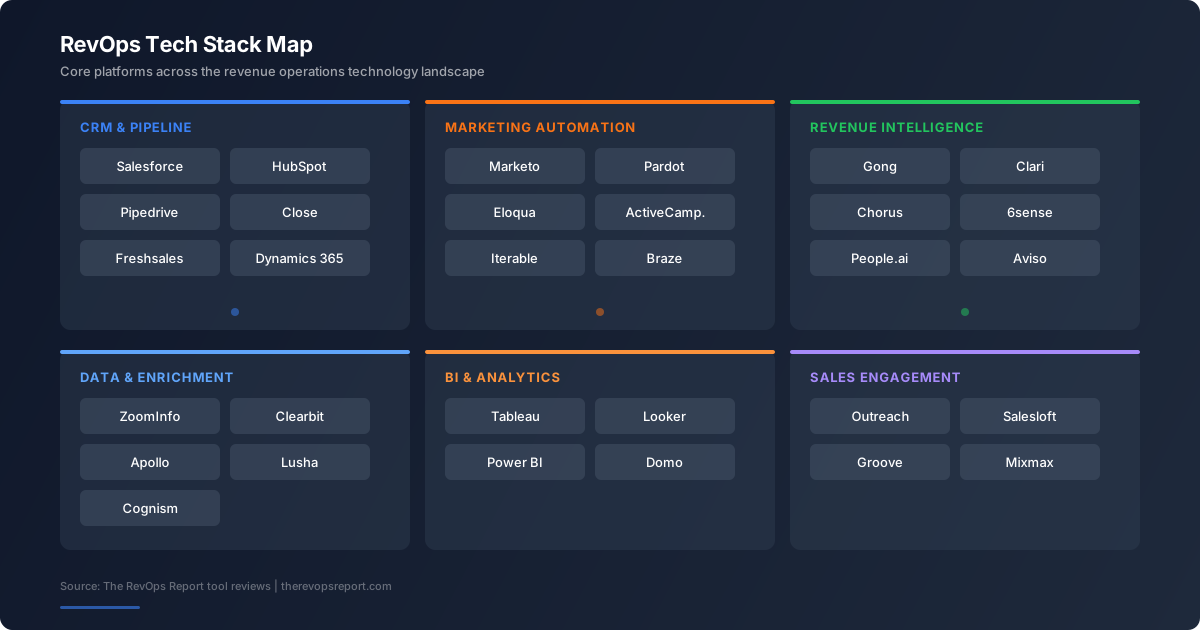
Many mid-market and enterprise RevOps teams use Clay for enrichment and Apollo as one of the data sources Clay queries, or use Apollo for prospecting and Clay to enrich the results before pushing to CRM. These tools are complementary more than competitive. The "both" approach works well if you can justify the combined cost and have ops bandwidth to manage two platforms.

What This Means for Your Stack

RevOps-Specific Considerations

  • Clay credit consumption is hard to predict. Waterfall enrichment means each record can burn 3-10 credits depending on how many providers you query. Model your monthly enrichment volume carefully before committing to a plan tier.
  • Apollo data quality varies by segment. Tech companies in the US have strong coverage. Niche industries, international markets, and SMB contacts have notable gaps. Test with your actual ICP before buying annual.
  • CRM write-back differs significantly. Apollo has native bidirectional sync with Salesforce. Clay requires you to build the write-back workflow yourself, which gives more control but demands more ops time.
  • Duplicate management is critical with both tools. Apollo can create duplicate contacts if your CRM dedup rules do not catch them. Clay workflows need explicit dedup steps built in or records will proliferate.
  • Compliance implications: Clay aggregates data from many sources, which can complicate your GDPR data-source documentation. Apollo owns their database, making data provenance simpler to document for compliance audits.

Winner by Use Case

Use CaseWinnerWhy
Data enrichment qualityClayWaterfall across 75+ providers beats any single source
All-in-one prospectingApolloDatabase + sequences + dialer in one platform
Budget under $200/moApolloFree tier and low per-user pricing
Complex enrichment logicClayCustom workflows with conditional logic
CRM integration easeApolloNative Salesforce/HubSpot sync out of the box
Enterprise data opsClayFlexibility for custom data pipelines and research

The RevOps Report's Bottom Line

Clay and Apollo are not direct substitutes. Clay is a data orchestration platform for RevOps teams that need maximum enrichment quality and custom workflow logic. Apollo is an all-in-one prospecting tool for teams that want simplicity. If you have a dedicated ops person who can build and maintain Clay workflows, the data quality advantage is real. If you need reps prospecting and emailing from one interface with minimal ops involvement, Apollo is the practical choice. Many mature teams use both: Apollo as a data source within Clay, or Clay for enrichment with Apollo for outbound execution.

Get Weekly RevOps Intelligence

Tool reviews, salary benchmarks, and stack recommendations for RevOps leaders.

Subscribe Free
Disclosure: The RevOps Report may receive affiliate compensation from tools mentioned here. Our analysis is independent. Every claim is based on publicly available data and user feedback.
Last Updated: January 2026