Duplicate records are the tax RevOps teams pay for growth. Every form fill, list import, and integration sync creates potential duplicates that pollute reports, confuse reps, and inflate pipeline numbers. Cloudingo is a Salesforce-native deduplication tool that has been solving this specific problem since 2011. It does one thing, and it does it well.
⚡
The Verdict: Cloudingo is the practical choice for Salesforce-centric RevOps teams that need reliable deduplication and data cleansing without the overhead of an enterprise data orchestration platform. The Salesforce-native architecture means zero sync issues, the matching algorithms are configurable enough for real-world data messiness, and the pricing is accessible starting at around $1,096/year. It won't solve your entire data quality problem, but it will solve the duplicate problem, which is often the most urgent one.
Salesforce
Native Platform
$1,096+
Starting Annual Price
Since 2011
Market Presence
4.3/5
G2 Rating
Company Overview
What Is Cloudingo, from a RevOps Seat?
Cloudingo is a Salesforce-native data quality tool focused on deduplication, merging, and data cleansing. It operates directly on your Salesforce data without requiring an external database or middleware layer. For RevOps teams running on Salesforce, that native architecture is a meaningful advantage: there's no sync lag, no data residency concerns, and no API limit headaches from constant bi-directional pushes.
The core workflow is straightforward. Cloudingo scans your Salesforce org against configurable matching rules, identifies duplicate leads, contacts, and accounts, and gives you options to merge automatically or review manually. The matching engine supports exact match, fuzzy match, phonetic matching, and custom rule combinations. You define what constitutes a duplicate for your business, and Cloudingo finds them.
Beyond deduplication, Cloudingo handles data cleansing tasks: standardizing field values, fixing formatting inconsistencies, and flagging incomplete records. It's not a full data orchestration platform like Openprise, and it doesn't pretend to be. It's a focused tool that solves the most common data quality problems in Salesforce orgs.
Where Cloudingo earns its keep in a RevOps stack is during high-volume operations: list imports, migration projects, and integration syncs that flood Salesforce with potential duplicates. A single webinar with 2,000 registrants can create hundreds of duplicate leads if your MAP sync runs before dedup catches them. Cloudingo's scheduled jobs and real-time prevention layer give you a safety net that Salesforce's native duplicate management rules simply cannot match in configurability or accuracy.
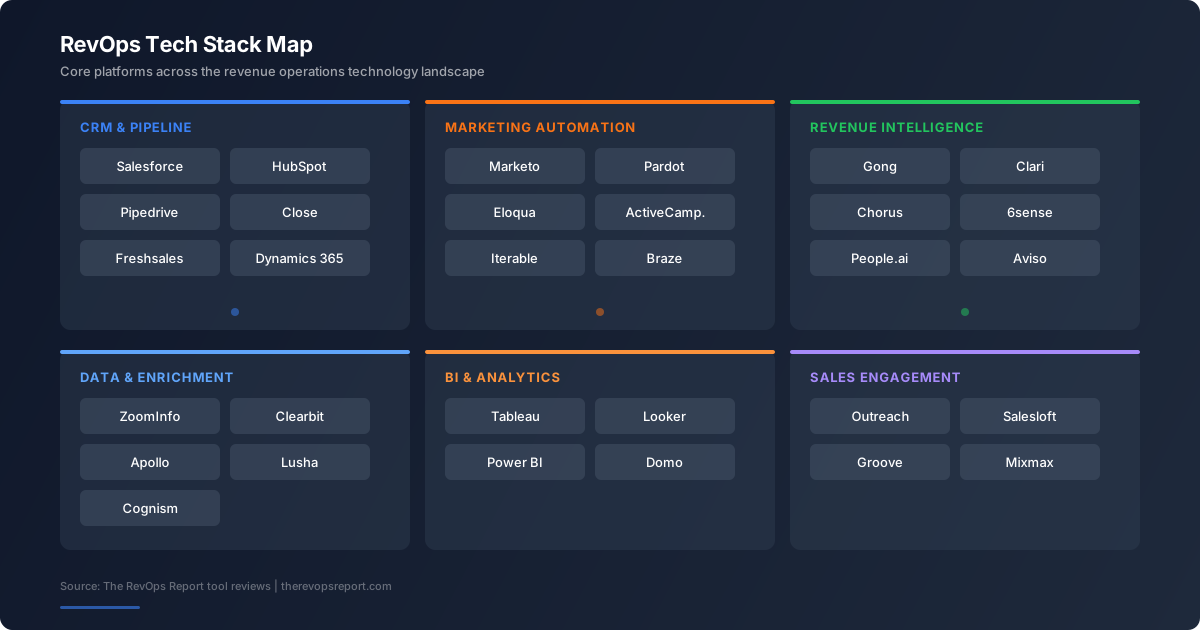
The tool also plays well with the rest of your data quality stack. Most mature RevOps teams pair Cloudingo with an enrichment vendor (ZoomInfo, Clearbit, Apollo) and a routing tool (LeanData, Chili Piper). Cloudingo handles the dedup and cleansing layer while the other tools handle enrichment and distribution. That modular approach keeps costs down and avoids overbuying into a platform you only need for one function.
💡
RevOps Reality Check
Cloudingo is purpose-built for Salesforce. If your CRM is HubSpot, Dynamics, or anything else, this tool is not an option. The native architecture is its strength, but it also means complete platform lock-in to the Salesforce ecosystem.
Pricing
What Cloudingo Costs
Cloudingo offers tiered pricing based on features and record volume. The pricing is transparent compared to most data quality vendors, with published tiers that let you build a business case without sitting through a sales demo.
Plan
Price
What’s Included
Essentials
$1,096/year
Basic deduplication, manual merge, standard matching rules, single object support Start Here
Professional
$3,000/year
Multi-object dedup, automated merging, scheduled jobs, advanced matching, data cleansing Most Popular
Enterprise
$6,000/year
Cross-object matching, API access, advanced automation, priority support
Enterprise Plus
$10,000/year
Full platform, unlimited automation, custom rules, dedicated support, sandbox access Large Orgs
Keep In Mind
All plans are annual contracts. Monthly billing is not available.
Pricing scales with Salesforce org size and record volume. The published prices are baselines; larger orgs may see adjusted quotes.
Sandbox access is only included in Enterprise Plus. Lower tiers test in production, which adds risk.
Implementation is typically self-service. Cloudingo provides documentation and support, but there's no mandatory onboarding fee.
Core Features
What Cloudingo Does Well
🔍
Configurable Matching Engine
Exact, fuzzy, phonetic, and custom rule matching across leads, contacts, and accounts. Define what 'duplicate' means for your specific data patterns.
🔄
Automated Merge Workflows
Schedule deduplication jobs to run on a cadence. Set merge rules for surviving record selection, field-level winner logic, and related record reassignment.
📋
Data Cleansing Tools
Standardize field values, fix formatting, and flag incomplete records. Handles common issues like state abbreviations, phone formatting.
⏱
Real-Time Prevention
Block duplicates at the point of entry. When a new record is created in Salesforce, Cloudingo can check for matches and alert or prevent the duplicate.
🔒
Salesforce-Native Architecture
Operates directly on Salesforce data without external databases or middleware. No sync delays, no API limit concerns from constant data movement.
📊
Merge Audit & Reporting
Track every merge operation with full audit trails. See what was merged, which record survived, and what field values changed.
Limitations
Where Cloudingo Falls Short
No tool is perfect. Here are the real trade-offs you should know about:
Salesforce-Only Limits Its Reach
Cloudingo's native architecture is its biggest strength and its most significant limitation. If your data quality issues extend beyond Salesforce into.
"Cloudingo cleaned up our Salesforce beautifully, but we still had duplicate issues in Marketo that kept re-syncing dirty data back in. You need to solve the problem at every entry point."
Marketing Ops Manager, Mid-Market SaaS
Complex Matching Requires Careful Configuration
The matching engine is flexible, but getting the rules right takes iteration. Too aggressive and you're merging distinct records.
Limited Beyond Dedup and Cleansing
Cloudingo does deduplication and basic data cleansing well. It does not handle enrichment, lead routing, waterfall logic, or multi-system orchestration.
"We use Cloudingo for dedup and it's great at that. But our data quality stack also includes ZoomInfo for enrichment and LeanData for routing. Cloudingo is one piece of the puzzle, not the whole thing."
RevOps Lead, Series B SaaS
Evaluation
Pros and Cons Summary
+ The Good Stuff
Salesforce-native architecture means zero sync issues and no API limit headaches.
Accessible pricing starting at $1,096/year makes it viable for smaller Salesforce orgs.
Configurable matching engine handles real-world data messiness with fuzzy and phonetic options.
Real-time duplicate prevention catches duplicates before they enter your CRM.
Self-service implementation keeps total cost of ownership low.
Audit trails on every merge operation provide compliance coverage and rollback capability.
- The Problems
Salesforce-only. Not an option if your CRM is anything else.
Matching rules require careful tuning. Expect 2-4 weeks of iteration before trusting automation.
No enrichment, routing, or orchestration capabilities. It solves one problem only.
Sandbox access locked to the highest pricing tier adds risk for lower-tier customers.
Complex cross-object deduplication requires the Enterprise tier at $6K+/year.
No native integration with non-Salesforce data sources for comprehensive data quality.
Decision Framework
Should You Buy Cloudingo?
BUY CLOUDINGO IF
✅
Salesforce duplicates are your most urgent data problem
If your Salesforce org is drowning in duplicate records and you need a focused, affordable solution that works natively with your CRM, Cloudingo is the.
Your CRM is Salesforce and you have a meaningful duplicate record problem (5%+ duplicate rate).
You need both batch cleanup and ongoing real-time duplicate prevention.
Your budget for data quality tooling is under $10K/year and you need immediate impact.
You want a self-service tool that doesn't require a dedicated admin or professional services.
Compliance requirements demand audit trails on data merge operations.
SKIP CLOUDINGO IF
❌
Your data quality challenges go beyond Salesforce dedup
Teams with multi-system data quality issues, enrichment needs, or complex orchestration requirements will find Cloudingo too narrow for their full problem set.
Your CRM is not Salesforce. Cloudingo has no cross-platform support.
You need enrichment, routing, or data orchestration alongside deduplication.
Your duplicate problem spans multiple systems (CRM, MAP, data warehouse).
You need custom object deduplication beyond standard leads, contacts, and accounts.
Your data quality strategy requires a platform approach, not a point solution.
Enterprise teams needing multi-system data management
DemandTools (Validity)
Custom pricing
Salesforce data management suite
Teams wanting dedup plus broader Salesforce data tools
Duplicate Check (app)
From $19/user/mo
Real-time prevention focus
Small orgs needing simple duplicate blocking
🔍 Questions to Ask Before Signing
What's our current duplicate rate in Salesforce? Run a duplicate analysis before purchasing. If your duplicate rate is under 2%, the ROI may not justify even the entry tier. Over 5% and Cloudingo pays for itself quickly.
Where are duplicates entering our system? Map every data entry point: web forms, list imports, integrations, manual entry. Cloudingo prevents duplicates in Salesforce, but if the source is a MAP sync, you need to fix it there too.
What are our merge rules for surviving records? Define which record wins when duplicates merge. Most-recently-updated? Most-complete? Oldest? Get alignment from sales and marketing before configuring.
Do we need sandbox testing before production merges? If yes, budget for Enterprise Plus tier. Lower tiers operate in production only, which means careful configuration is critical.
What other data quality tools do we need alongside Cloudingo? Cloudingo solves dedup. You likely also need enrichment (ZoomInfo, Clearbit) and routing (LeanData). Build the full stack plan, not just the dedup piece.
How will we handle duplicates created by MAP syncs and integrations? Cloudingo's real-time prevention catches duplicates at creation, but only within Salesforce. If your Marketo or HubSpot sync is creating duplicates upstream, you need to fix the source. Map every integration that writes to Salesforce and decide where dedup happens in the flow.
What's our rollback plan if automated merges go wrong? Bad merge rules can destroy data. Cloudingo's audit trail helps, but Salesforce field history has limits. Before enabling automated merges, establish a backup cadence and test your merge rules on a small batch first. The Enterprise Plus tier's sandbox access eliminates this risk.
FAQ
Frequently Asked Questions
How do RevOps teams use Cloudingo?
RevOps teams use Cloudingo primarily for three workflows: bulk deduplication after list imports or migration projects, ongoing scheduled dedup jobs that run weekly or daily to catch duplicates from web forms and MAP syncs, and real-time duplicate prevention that blocks duplicates at the point of Salesforce record creation. The most common setup is Professional tier with weekly automated merge jobs and real-time prevention enabled on lead and contact objects. Teams typically pair Cloudingo with an enrichment vendor and a routing tool for a complete data quality stack.
Is Cloudingo worth it for RevOps?
Cloudingo is worth it if your Salesforce duplicate rate exceeds 5% and duplicates are actively causing problems: inflated pipeline, misrouted leads, or unreliable reporting. At $1,096/year for the entry tier, the ROI math is straightforward. If a single misrouted enterprise lead costs you $50K in pipeline, Cloudingo pays for itself the first time it catches a duplicate that would have gone to the wrong rep. For orgs with clean data under 2% duplicate rates, the investment is harder to justify. Run a duplicate analysis first.
How much does Cloudingo cost?
Cloudingo pricing starts at $1,096/year for Essentials (basic dedup, manual merge, single object). Professional runs $3,000/year and adds automated merging, scheduled jobs, and multi-object dedup, which is where most RevOps teams land. Enterprise at $6,000/year adds cross-object matching and API access. Enterprise Plus at $10,000/year includes sandbox access, unlimited automation, and dedicated support. All plans are annual contracts with no monthly option. Pricing may adjust upward for very large Salesforce orgs.
What are the main limitations of Cloudingo?
Three limitations matter most for RevOps. First, it is Salesforce-only with zero support for HubSpot, Dynamics, or any other CRM. Second, it only does deduplication and basic cleansing. No enrichment, no routing, no orchestration. You will need additional tools for those functions. Third, the matching engine requires careful tuning. Too aggressive and you merge distinct records. Too conservative and duplicates slip through. Budget 2-4 weeks of iteration before trusting automated merges. Sandbox testing is locked to the $10K/year Enterprise Plus tier, which adds risk for lower tiers.
Cloudingo vs DemandTools for Salesforce dedup?
Cloudingo and DemandTools (by Validity) are the two primary Salesforce dedup tools. Cloudingo is more focused: dedup and cleansing with accessible pricing starting at $1,096/year. DemandTools is part of Validity's broader suite that includes email verification (Everest) and data management tools, so it appeals to teams wanting a wider toolkit. Cloudingo's real-time duplicate prevention is stronger out of the box. DemandTools offers more data manipulation capabilities beyond dedup. For pure deduplication, Cloudingo is simpler and cheaper. For broader Salesforce data management, DemandTools has more surface area.
The RevOps Report’s Bottom Line
Cloudingo does what it says: it finds and merges duplicate records in Salesforce, and it does it reliably with a configurable matching engine and accessible pricing. For Salesforce-centric RevOps teams, the native architecture eliminates the sync and API concerns that plague external dedup tools. It's not a platform play, and it won't solve enrichment, routing, or multi-system data quality. But if your most pressing data problem is Salesforce duplicates, Cloudingo is the focused, affordable answer. Start with the Professional tier for automated merging and upgrade if you need cross-object matching.
But know the trade-offs:
Run a duplicate analysis first to quantify the problem. That baseline justifies the spend and measures success.
Invest 2-4 weeks in tuning matching rules before enabling automated merges. The upfront effort prevents bad merges.
Plan the full data quality stack, not just dedup. Cloudingo is one piece; enrichment and routing are separate decisions.
About the Author
Rome Thorndike is VP of Revenue at Firmograph.ai, where he builds AI agents that analyze GTM data for revenue leaders. His career spans enterprise sales at Salesforce and Microsoft, helping scale Sequoia-backed Snapdocs from Series A through Series D, and leading sales at Datajoy through its acquisition by Databricks. Rome holds an MBA from UC Berkeley Haas with a focus on statistical analysis and machine learning.
Disclosure: The RevOps Report may receive affiliate compensation from tools mentioned here. Our analysis is independent. Every source is linked. Every claim is verifiable.
Get RevOps Intel
Weekly market data + quarterly State of RevOps reports. Free.