
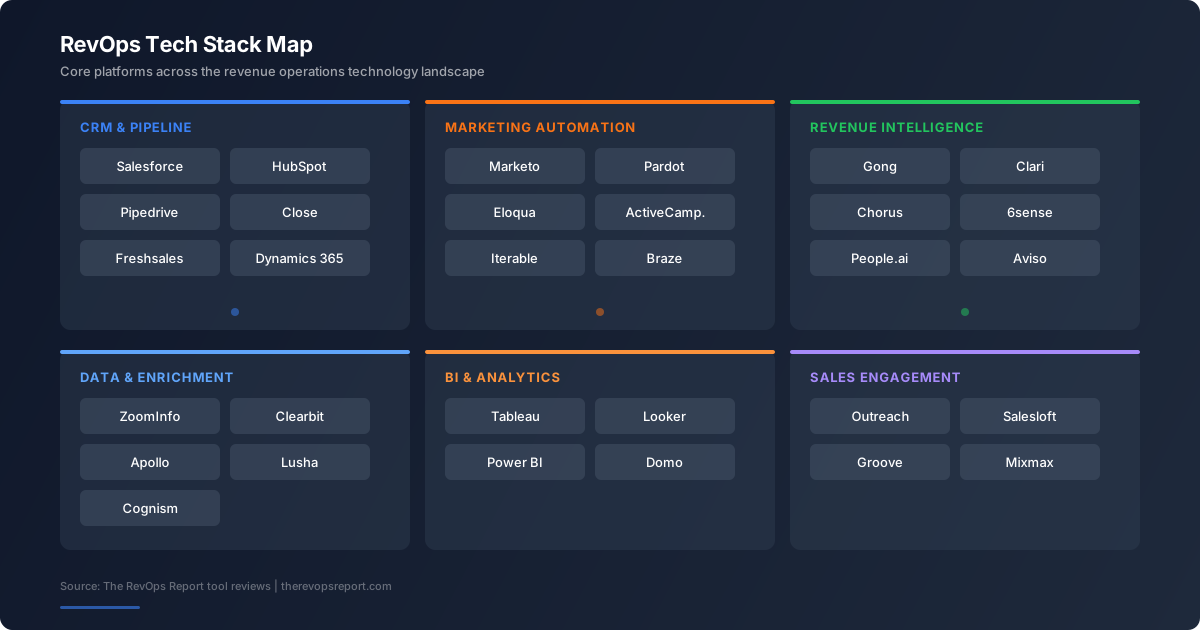
Pardot -- or as Salesforce now insists you call it, "Marketing Cloud Account Engagement," which is the kind of name that happens when a branding committee has too many meetings and not enough taste -- is the Salesforce-native marketing automation platform. HubSpot is the all-in-one platform that bundles marketing, sales, service, and Operations Hub. The core tension: Pardot wins when you are fully committed to Salesforce and want zero-friction data flow between your MAP and CRM. HubSpot wins on everything else -- UX, total cost, platform breadth, and the RevOps-specific tooling that Pardot does not have. If your Salesforce instance is the center of your universe, Pardot is the path of least resistance. If you are willing to run a different vendor for marketing automation, HubSpot gives you more for less.
| Factor | Pardot | HubSpot |
|---|---|---|
| Pricing | $1,250/mo (Growth) to $4,000+/mo (Advanced/Premium) Premium for Salesforce tax | Free CRM; Marketing Hub from $800/mo (Professional) Lower entry point |
| CRM Integration | Native Salesforce — same platform, same data model, zero sync lag Best Salesforce integration possible | Native HubSpot CRM; Salesforce connector available but requires configuration Good, not native |
| Learning Curve | Moderate to steep; Salesforce familiarity helps but UI is dated Clunky interface | Low to moderate; most marketers productive in 2-4 weeks Best-in-class UX |
| Automation Builder | Engagement Studio with branching logic and wait steps Functional but dated | Visual workflow builder with branching, delays, and if/then logic Modern and intuitive |
| Reporting | B2B Marketing Analytics (Salesforce-native dashboards) Unified with SF reporting | Built-in attribution reporting, campaign analytics, revenue reporting Self-contained |
| AI Features | Einstein for scoring and send-time optimization Improving | HubSpot AI for content generation, predictive scoring, chatbots Broader AI surface |
| Platform Breadth | Marketing automation only; sales/service are separate Salesforce products | Marketing + Sales + Service + CMS + Operations Hub on one platform All-in-one |
| Implementation | 4-8 weeks (assumes existing Salesforce instance) Salesforce dependency | 2-6 weeks Faster standalone deployment |
| Feature | Pardot | HubSpot |
|---|---|---|
| Email Builder | Template-based with merge fields; functional but UI lags modern standards | Drag-and-drop with smart content, A/B testing, and AI-generated copy Better UX |
| Lead Scoring | Einstein Lead Scoring + manual scoring rules synced to Salesforce Deep SF integration | Predictive scoring + manual scoring; adequate for most orgs |
| Landing Pages | Basic landing page builder; most teams use a separate CMS Weak | Drag-and-drop pages with smart content, personalization, and A/B testing Much stronger |
| Operations Hub | N/A — no equivalent; use Salesforce Flow or third-party tools | Data sync, data quality automation, programmable automation (custom code) RevOps-specific |
| Account-Based Marketing | Salesforce ABM features (account scoring, buying groups) Native ABM in Salesforce | Target accounts, ABM dashboard, company scoring |
| Forms & Progressive Profiling | Progressive profiling with dependent fields Strong | Progressive profiling with smart forms and pop-ups Strong |
Some organizations run HubSpot for marketing automation with Salesforce for CRM, syncing via the HubSpot-Salesforce connector. This is the "best of both worlds" approach and it works well for most use cases. The connector handles lead sync, campaign attribution, and field mapping. Where it breaks down: complex custom objects, large data volumes (100K+ records syncing), and real-time sync requirements. If neither Pardot nor HubSpot fits, Marketo ($895-3,175+/mo) is the enterprise alternative with the deepest Salesforce integration after Pardot, and ActiveCampaign ($49-149/mo) covers SMB marketing automation without enterprise complexity.
| Use Case | Winner | Why |
|---|---|---|
| Salesforce-native automation | Pardot | Same platform, same data model, zero integration layer |
| All-in-one marketing platform | HubSpot | Marketing + Sales + Service + CMS + Ops on one platform |
| Budget-conscious teams | HubSpot | $800/mo with free CRM vs $1,250/mo plus Salesforce license |
| RevOps data operations | HubSpot | Operations Hub data sync and programmable automation |
| Deep Salesforce CRM integration | Pardot | Native data access to custom objects, record types, and automation |
Pardot exists because Salesforce needed a marketing automation product to prevent customer attrition to HubSpot. That is not a cynical take -- it is the strategic reality. Pardot's value proposition is entirely derivative of Salesforce CRM: it is good because it is native, not because it is good. HubSpot is the better marketing automation platform on features, UX, cost, and breadth. But "better" does not account for the switching cost of leaving Salesforce's native ecosystem. If your Salesforce instance is heavily customized and marketing segmentation depends on complex CRM data, Pardot's native access is worth the premium. If your Salesforce usage is standard and your marketing team would rather build campaigns without submitting a Jira ticket to your Salesforce admin, HubSpot saves you money and gives your marketers their time back.
Tool reviews, salary benchmarks, and stack recommendations for RevOps leaders.
Subscribe Free