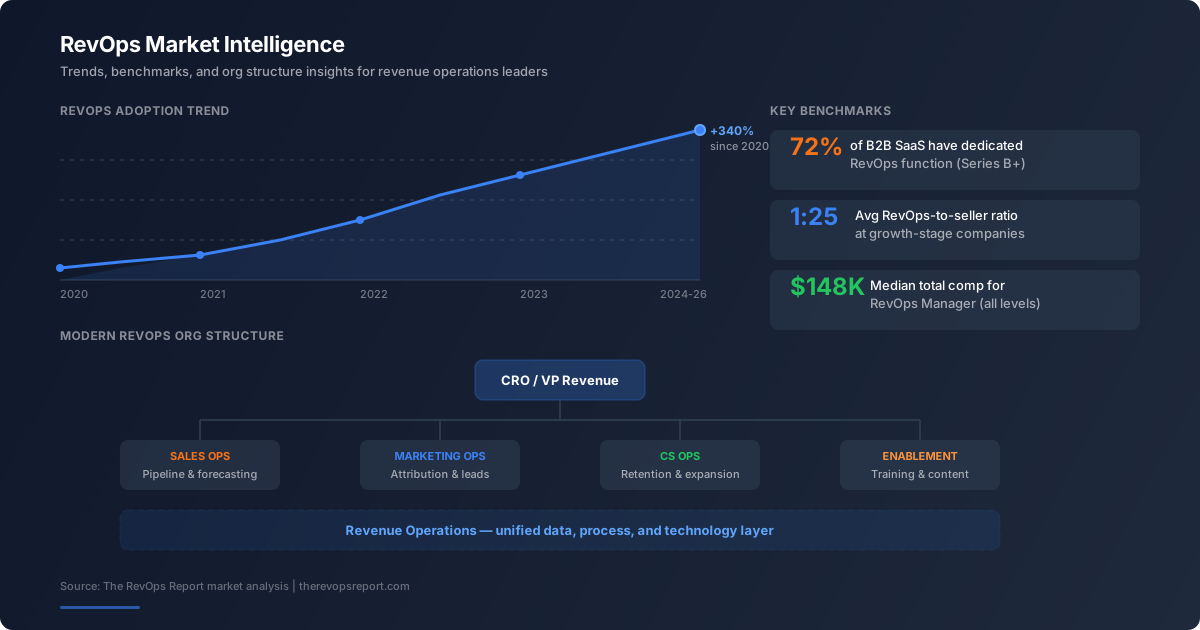
What Is RevOps? is RevOps (Revenue Operations) is the strategic function that unifies sales, marketing, and customer success operations under a single team to eliminate silos, improve data accuracy, and accelerate revenue growth across the full customer lifecycle.
RevOps (short for Revenue Operations) is the operational discipline that owns the systems, data, and processes a B2B company uses to generate, capture, and retain revenue. The function consolidates the historically separate Sales Operations, Marketing Operations, and Customer Success Operations into a single team with one data model, one tech stack, and one accountability framework for revenue performance.
The reason the function exists is that B2B revenue teams kept building the same things three times. Sales Ops built a forecasting model. Marketing Ops built a funnel dashboard. CS Ops built a renewal tracker. All three used different definitions of "customer," different data sources, and different tools. The result was conflicting numbers, broken handoffs, and executives who could not get a straight answer about pipeline health. RevOps fixes that by putting the operational layer under a single function with a single source of truth.
What RevOps Actually Owns
The scope varies by company stage but the core ownership is consistent across mature RevOps functions in 2026.
Data architecture and quality: A unified data model across CRM, marketing automation, customer success platform, and billing. One definition of "customer," one source of truth for pipeline. Ongoing data hygiene programs that keep the data reliable enough for forecasting and reporting.
Tech stack ownership: Evaluating, implementing, integrating, and pruning the RevOps tool stack. The average B2B SaaS company runs 50-200+ go-to-market tools. Someone needs to own the revenue stack and prevent tool sprawl from degrading data quality.
Process design across the funnel: Lead routing, opportunity management, handoff workflows between Marketing and Sales, renewal processes, expansion motions, and the SLAs that govern each handoff. RevOps designs the process, sales and marketing execute it.
Analytics, forecasting, and reporting: Pipeline reporting, revenue forecasting, win/loss analysis, performance dashboards, and the executive reporting that the CRO and board consume. Forecast accuracy is the single most-measured RevOps outcome.
Territory, quota, and compensation operations: Territory design, quota modeling, compensation plan administration, and the quarterly sales planning cycle. RevOps does not own the comp plan strategy but owns the operational execution.
Strategic GTM projects: Pricing model changes, segment expansion analysis, sales motion redesign, ICP refinement, and the cross-functional initiatives that change how revenue is generated.
RevOps vs Sales Ops vs Marketing Ops
The taxonomy matters because the categories get conflated constantly.
Sales Operations serves the sales team only. Sales Ops owns CRM administration for sales workflows, pipeline reporting, sales tool stack, sales process documentation, and the operational support for the sales VP. Reporting line is usually under the CRO or VP of Sales.
Marketing Operations serves the marketing team only. MOps owns marketing automation administration, lead lifecycle management from MQL to SQL handoff, attribution reporting, marketing tool stack, and campaign operations. Reporting line is usually under the CMO.
Customer Success Operations serves the customer success team only. CS Ops owns CS platform administration, health scoring, renewal pipeline reporting, and the operational layer for retention and expansion motions. Reporting line is usually under the Chief Customer Officer or VP of Customer Success.
Revenue Operations owns all three of the above plus the cross-functional layer that connects them. RevOps reports either to the CRO or, increasingly, directly to the CEO as a peer to the CRO. The reporting line matters because cross-functional authority requires neutral positioning.
Many companies use these terms interchangeably or inconsistently. Some companies call their full-stack function "Sales Ops" because of historical naming. Others have a "RevOps" function that is really only Sales Ops with marketing reports added. The label matters less than the actual scope and reporting line. When evaluating a RevOps role or function, ask what it actually owns, not what it is called.
How RevOps Drives Revenue Growth
The mechanisms by which RevOps produces measurable revenue impact are concrete, not abstract.
Forecast accuracy. Better forecasting accuracy reduces costly overshoots and undershoots in hiring, capital allocation, and quarterly commitments. Top-quartile RevOps functions hit forecast accuracy within 5%, which translates directly to leadership confidence and better resource decisions.
Pipeline efficiency. Better lead routing, faster speed-to-lead, and tighter MQL definitions improve conversion from top-of-funnel to closed-won. A 10-15% improvement in MQL to SQL conversion produces meaningful pipeline lift without adding headcount.
Sales productivity. Cleaner CRM data, better automation, and reduced manual work give reps more time on revenue-generating activities. The benchmark is reps spending 60%+ of their time on selling activities, not data entry. RevOps closes the gap.
Retention and expansion. Better health scoring, better renewal pipeline management, and operational support for expansion motions improve net revenue retention. NRR above 115% is a common RevOps outcome.
Decision quality. Reliable data and consistent metrics let leadership make decisions on facts rather than narrative. The compounding value of better decisions is the largest long-run RevOps benefit, even though it is the hardest to attribute directly.
The RevOps Org Structure (By Company Stage)
RevOps team structure scales with company size and complexity. The typical progression:
Pre-RevOps (under $5M ARR): No dedicated function. A founder, sales leader, or first sales hire owns CRM administration alongside their primary role. Tooling is minimal. Process is informal.
First RevOps hire ($5-20M ARR): One generalist who owns CRM administration, basic reporting, lead routing, and tool integrations. Often comes from a Sales Ops or RevOps Analyst background. The first hire defines the function.
Small RevOps team ($20-50M ARR): 2-5 person team. Specialization starts: typically a RevOps lead, a Sales Ops or Marketing Ops specialist, and a CRM administrator. Process documentation becomes formal. Forecasting moves out of spreadsheets into a dedicated tool.
Mid-stage RevOps ($50-150M ARR): 5-15 person team with clear specialization between Sales Ops, Marketing Ops, and CS Ops sub-functions all under a Director or VP of RevOps. Strategic projects (territory redesign, pricing, sales motion changes) become recurring work.
Mature RevOps ($150M+ ARR): 15-50+ person team with a VP or SVP of RevOps reporting to CRO or CEO. Specializations include data engineering, GTM systems, sales planning, deal desk, and analytics. The function is strategic and operates as a peer to Sales, Marketing, and CS leadership.
RevOps by the Numbers
Companies with a dedicated RevOps function grow revenue 3x faster than those without one (Forrester research). The median RevOps salary in the US sits around $130K-$145K for individual contributors, with Director roles in the $180-220K range and VP-level roles exceeding $250K-$350K in major metros. The function has grown 300%+ in job postings since 2019, making it one of the fastest-growing operational disciplines in B2B.
The compensation premium reflects the demand. Most B2B SaaS companies above $20M ARR now have a dedicated RevOps function or are hiring one. Below $20M ARR, the function exists informally and is usually consolidated into a single hire. Above $100M ARR, RevOps becomes a strategic peer to Sales and Marketing leadership rather than a support function.
The RevOps Tool Stack
RevOps owns or governs most of the go-to-market tool stack. The categories that matter:
CRM platform: Salesforce or HubSpot for most B2B companies. The system of record for accounts, contacts, opportunities, and pipeline.
Marketing automation: Marketo, HubSpot Marketing Hub, or Pardot for lead lifecycle, scoring, and nurture.
Sales engagement: Outreach, Salesloft, or Apollo for sequencing and prospecting workflows.
Revenue intelligence and forecasting: Clari, BoostUp, or Aviso for pipeline analytics and forecast accuracy.
Conversation intelligence: Gong or Chorus for call recording and deal-level insights.
Lead routing and matching: LeanData or HubSpot Operations Hub for routing logic and lead-to-account matching.
Data orchestration and enrichment: Clay, Openprise, or Syncari for cross-system data workflows.
Data hygiene: DemandTools, Cloudingo, or RingLead for deduplication and data quality.
BI and analytics: Tableau, Looker, or Power BI on top of a data warehouse for cross-system reporting.
The stack is large because revenue operations span many tools. RevOps owns evaluating new tools, integrating them with existing systems, governing usage, and pruning the stack as products consolidate or duplicate.
How to Get Into RevOps
The most common paths into RevOps in 2026:
Sales Ops to RevOps: The most natural path. A Sales Ops practitioner expands scope to include marketing operations and CS operations, eventually owning the full revenue function.
Marketing Ops to RevOps: Marketing Ops practitioners with strong CRM and analytics skills move into RevOps when their scope expands beyond marketing.
Salesforce admin to RevOps: A Salesforce admin who develops business acumen and analytics skills can move into RevOps. The technical CRM foundation is the differentiator.
Business analyst or strategy to RevOps: Analysts with strong SQL, business judgment, and operational instincts can break in, especially at growing companies that need RevOps generalists.
Sales or BDR to RevOps: Less common but possible. Reps who developed strong analytical and process design skills can transition. Usually requires self-taught CRM administration.
Revenue Intelligence: the data and analytics layer that informs RevOps decisions.
Buying Committee Analysis: the buying-group orchestration motion that mature RevOps teams now operate.
Frequently Asked Questions
What does a RevOps team do day to day?
Day-to-day work includes CRM administration, pipeline reporting, lead routing optimization, tool integrations, data cleanup, dashboard building, and process documentation. Strategic work includes forecasting methodology, territory design, tech stack evaluation, and cross-functional alignment between Sales, Marketing, and CS. The split between operational and strategic work shifts as RevOps practitioners grow into senior roles. Junior practitioners spend more time on operational tasks. Senior practitioners spend more time on strategic projects, with operational work delegated to the broader team.
How is RevOps different from Sales Ops?
Sales Ops serves the sales team only. RevOps spans Sales Ops, Marketing Ops, and CS Ops under one function. The scope is broader, the data model is unified, and the mandate is full-funnel revenue optimization rather than single-department support. RevOps usually reports to the CRO or directly to the CEO as a peer to the CRO. Sales Ops typically reports to the VP of Sales. The reporting structure matters because cross-functional authority requires neutral positioning above any single department head.
What is RevOps in simple terms?
RevOps is the team that owns the systems, data, and processes a B2B company uses to make money. Sales, marketing, and customer success use those systems to do their jobs. RevOps makes sure the systems work well together, the data is reliable, and the handoffs between teams do not drop the ball. Without RevOps, each team builds its own dashboards and uses its own definitions, which produces conflicting numbers and broken processes. With RevOps, there is one source of truth for revenue.
Why is RevOps important?
RevOps is important because B2B revenue increasingly depends on multiple teams (sales, marketing, customer success) working from the same data and processes. Companies with dedicated RevOps functions grow revenue 3x faster than those without one (Forrester). The function eliminates the operational drag that comes from siloed teams: conflicting metrics, broken handoffs, manual data work, and inaccurate forecasts. RevOps makes the revenue engine more reliable, more efficient, and easier to scale.
What skills does a RevOps person need?
Core skills are CRM administration (Salesforce or HubSpot), SQL for data analysis, spreadsheet modeling for pipeline and forecasting work, process design for cross-functional workflows, and business acumen to translate business problems into operational solutions. Soft skills include cross-functional communication (RevOps works with sales, marketing, CS, finance, and engineering), project management, and the ability to influence without authority. Senior RevOps roles add strategic skills: revenue model design, executive communication, vendor management, and team leadership.
What is the difference between RevOps and revenue intelligence?
RevOps is the operational function that owns the revenue systems and processes. Revenue intelligence is the data and analytics category that produces pipeline insights, forecast predictions, and deal-level signals. RevOps uses revenue intelligence tools (Clari, Gong, BoostUp) as part of its stack. Revenue intelligence is a tool category. RevOps is the function that operates the tools. Confusing them is common because vendor marketing blurs the line, but RevOps is the team and revenue intelligence is the software.
What is RevOps reporting?
RevOps reporting covers pipeline analytics, forecast accuracy, win rate, conversion metrics, sales productivity, data quality, and the operational metrics that drive revenue. RevOps owns the design and delivery of revenue reporting to the CRO, CFO, and executive team. The reporting cadence typically includes weekly pipeline reviews, monthly forecast reviews, quarterly business reviews, and annual strategic planning. The metrics framework is the most visible RevOps deliverable because executives see it constantly.
When should a company hire its first RevOps person?
Most B2B SaaS companies should hire their first RevOps person between $5M and $20M ARR. Below $5M ARR, the function can be handled by a founder, sales leader, or contractor. Above $20M ARR, the operational complexity (multiple tools, growing data volume, cross-functional handoffs) demands a dedicated owner. The first RevOps hire is typically a generalist who owns CRM administration, reporting, lead routing, and tool integrations. The hire defines the function, so prioritize candidates with broad scope, strong process design instincts, and the ability to operate independently.
What is the difference between RevOps and Revenue Operations?
There is no difference. RevOps is the shorthand for Revenue Operations. The terms are used interchangeably across job titles, team names, and industry conversation. Some companies use the full name (Revenue Operations) in formal contexts and the shorthand (RevOps) in casual contexts. Job titles increasingly use RevOps because it is shorter and has become the dominant industry term.
What is RevOps vs marketing operations?
Marketing Operations serves the marketing team only and owns marketing automation, lead lifecycle, attribution, and campaign operations. RevOps spans marketing operations plus sales operations and CS operations under a single function with cross-functional authority. A Marketing Ops practitioner reports to the CMO. A RevOps practitioner reports to the CRO or CEO. The functions overlap in lead lifecycle management and reporting, which is why MOps practitioners often transition into RevOps roles when their scope expands.